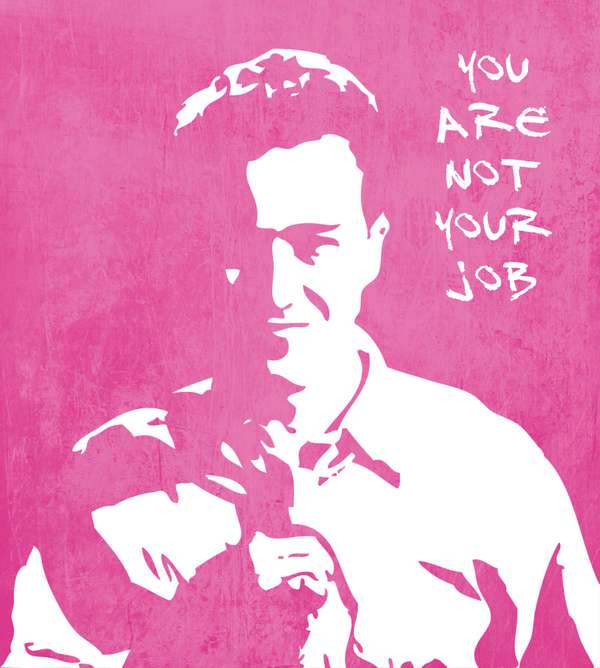
Nor the money you make or the car you drive or the contents of your wall or…
There was an interesting quote in Let’s Destroy Work, Let’s Destroy the Economy by Alfred M. Bonanno,
The post-industrial society, which we will come to later, has resolved the problem of unemployment, at least within certain limits, by dispersing the work force into flexible sectors which are easy to manoeuvre and control. In actual fact the social threat of growing unemployment is more theoretical than practical, and is being used as a political deterrent to dissuade wide social strata from attempting to organise in ways that might question the choices of neo-liberalism, especially at international level. So, precisely because workers are much easier to control when they are skilled and attached to the workplace with career prospects in the production unit, there is insistence everywhere — even among the ecclesiastical hierarchies — on the need to give people work and thereby reduce unemployment. Not because the latter constitutes a risk from the point of view of production, but because the danger could come from precisely that flexibility which is now indispensable to the organisation of production today. The fact that the worker has been robbed of a precise identity could lead to social disintegration, making control more difficult in the medium term. That is what all the institutional fuss about unemployment is really about. (emphasis added)
Whether we like it or not (and surely I don’t as you might guess) we are cast in these roles or social positions that we may not have much actually invested in. We may not actually want to be defined but what we do even though it takes up most of our lives. A teacher may spend a lot of their lives on certain projects or lessons but instead of being defined by those individual things they may instead want to be remembered for their personality throughout these experiences. Through the relationships they cultivated with others because of these lessons or the things they impart on others. Not merely just the job of being a teacher but what they actually did for other people within that role. How they handled this role and what they did to make it their own thing rather than what the external authorities told them it should be.
Of course some may go further. Maybe they spend most of their lives on certain things (like struggling to survive) but that doesn’t mean they want to be remembered for that given role. They may want to be more remembered for how they defied this certain role or perhaps want nothing to do at all with this role or being defined in relation to it. Sometimes that’s because this role hurt them or because they’d rather be known for what they’ve done then for what people told them they did.
The idea of careers have really damaged our individual identities because it locks us all up with certain expertise, skills, knowledge and makes us conflate having one narrow path of achievement as an achievement of life. And perhaps some truly are happy with such a narrow conquering of life, I don’t pretend to know otherwise. But doesn’t it seem more worthwhile to master more lines of achievement then just the one that we are given? Doesn’t it seem like life would be much more mastered and our lives much more directed towards ourselves then others?
But doing so, as Bonanno points out, makes the ruling class nervous. It makes them realize that our uniqueness can’t be merely confined to certain roles within a given economy.It makes them realize that their ability to sort, categorize and make legible our very lives can only go so far. That we can fight back and extend our own expertise and self-mastery over ourselves in unique and surprising ways that doesn’t always necessarily fit within the spectrum of “choices” that our masters gave us.
Developing our own choices doesn’t mean getting stuck in the same roles or narrowing our choices or broadening them to the point that they become meaningless or overwhelming for ourselves. It means having the ability to flourish under our choices that we ourselves create for our own lives, our loved ones, our friends, our communities or whatever pleases us and doesn’t trample on others.
What are we without our jobs?
For myself, I am my jokes and puns, my willingness to help others that I love, I am a person who likes putting smiles on other people’s faces, I am someone who loves my partner and loves making him as happy as I can. I am someone who is an anarchist, I hate work and love the work of Voltairine de Cleyre. I am someone who is always striving to better satisfy the world around me so that it may in turn satisfy myself. I am also someone who is moving from interest to interest, sometimes intensely and sometimes not as much so. I am someone who loves dogs.
But can we put all of these things together? Do we need some sort of particularized or defined role that has certain activities happen within it to define myself? For example I work with C4SS and I am trying to also start working with dogs, maybe become a writer at some point in the future and sell my work for whatever people feel its worth. Is defining myself by these things necessarily bad? Well, not if I enjoy these things and enjoy having them being a part of my life. If they exemplify certain parts of myself, my values, my personality, my ideology or whatever. If these things exemplify such things then I can’t say it matters to me too much if people know me by them.
The problem is is that today people aren’t just known by what they do but defined by it. They must live by it and die by it and if they don’t then they aren’t really worth the skin they inhabit, according to some. Adding to that these roles are often things that people aren’t interested in or don’t want to be known for but must be anyways due to the nature of our culture or society at large.
And although I am not a communist I cannot help but find this vision by Marx an attractive one:
…where nobody has one exclusive sphere of activity but each can become accomplished in any branch he wishes, society regulates the general production and thus makes it possible for me to do one thing today and another tomorrow, to hunt in the morning, fish in the afternoon, rear cattle in the evening, criticise after dinner, just as I have a mind, without ever becoming hunter, fisherman, herdsman or critic. (The German Ideology)
Likewise no one will be defined by one sphere of activity or another. They will be able to define themselves, their roles, their habits, their social and individual activities and so on.
We will know freedom and we will have abolished work.


